
In late 2022, the world changed overnight with the release of a simple chat interface that felt startlingly human. Fast forward to late 2025, and ChatGPT has evolved from a novelty into the operating system of the modern digital economy. With over 400 million weekly active users and the recent launch of GPT-5, understanding this technology is no longer optional—it is essential.
Whether you are a complete beginner asking “What is ChatGPT?” or a tech enthusiast looking for a deep dive into Transformer architecture and Agentic workflows, this guide covers it all.
Table of Contents
The Core Definition: What is ChatGPT?
At its simplest, ChatGPT (Chat Generative Pre-trained Transformer) is an artificial intelligence chatbot developed by OpenAI. It is designed to understand natural human language and generate responses that are often indistinguishable from those a human would write.
However, calling it a “chatbot” in 2026 is like calling a smartphone a “calculator.” It is a multimodal Large Language Model (LLM). This means it doesn’t just process text; it can see, hear, speak, and create.
Breaking Down the Acronym
To truly answer “What is ChatGPT?”, we must decode its name:
- Chat: Refers to the conversational interface. You talk to it, and it talks back.
- Generative: It creates new content. Unlike a search engine that finds existing pages, ChatGPT generates unique answers word-by-word.
- Pre-trained: Before it ever answers your first question, it has read a significant portion of the public internet (books, articles, code) to learn the patterns of language.
- Transformer: The specific neural network architecture that makes this all possible.
Key Statistic (2026): As of February 2026, ChatGPT processes over 15 billion requests per day, serving industries ranging from healthcare diagnostics to Hollywood screenwriting.
The Engine Under the Hood: How ChatGPT Works
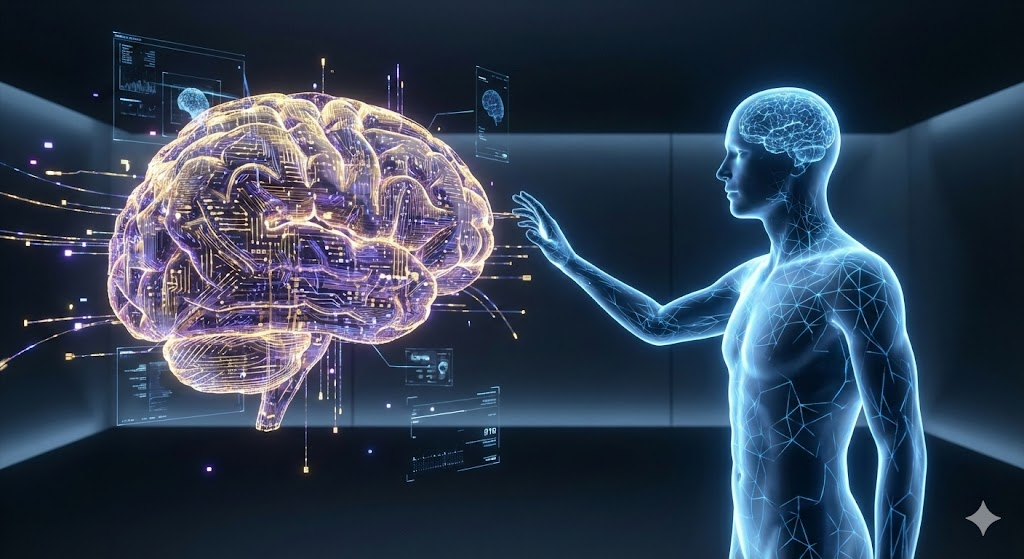
How does a computer program learn to tell jokes, write Python code, or summarize Shakespeare? The answer lies in Probability and Transformers.
1. The Transformer Architecture
Introduced by Google researchers in 2017, the Transformer is the deep learning architecture that powers ChatGPT. Unlike older AI models that read sentences left-to-right (and often forgot the beginning of a long sentence), Transformers use a mechanism called “Self-Attention.”
Imagine reading a complex paragraph. When you see the word “bank,” how do you know if it means a river bank or a financial bank? You look at the surrounding words. The Transformer does this mathematically, assigning an “attention score” to every word’s relationship with every other word in a sentence, simultaneously. This allows it to understand context, nuance, and long-term dependencies better than any previous technology.
2. Training: The Two-Step Process
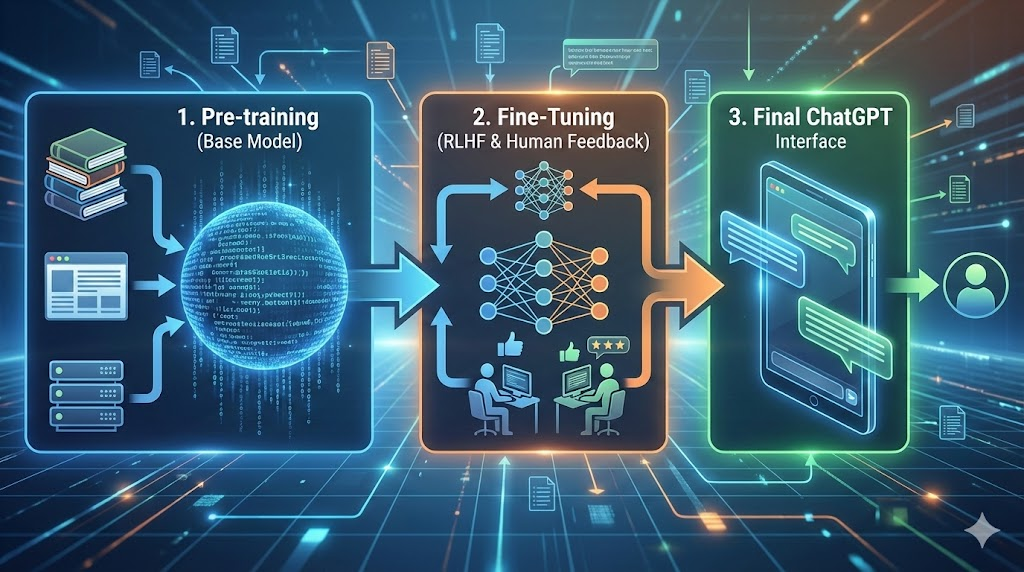
ChatGPT isn’t “programmed” with strict rules of grammar. It is “trained” in two massive phases:
Phase A: Pre-training (The Library)
The model is fed petabytes of text data. Its only goal is to play a game: “Guess the next word.”
- Input: “The cat sat on the…”
- Model Guesses: “Moon” (Wrong) -> “Mat” (Correct). By repeating this trillions of times, the model builds a statistical map of language. It learns that “Queen” is associated with “King” in the same way “Woman” is associated with “Man.”
Phase B: Fine-Tuning (RLHF)
If left alone, a pre-trained model might ramble or be rude. OpenAI uses Reinforcement Learning from Human Feedback (RLHF). Humans review the AI’s answers and rank them.
- Response A: Accurate and helpful.
- Response B: Rude and factually incorrect. The model is “rewarded” for producing Response A. This steers the raw intelligence toward being helpful, harmless, and honest.
A History of Intelligence: From GPT-1 to GPT-5
The evolution of ChatGPT is a story of exponential growth. In just seven years, we went from incoherent sentences to reasoning capabilities that rival PhD experts.
GPT-1 (2018)
- Parameters: 117 Million.
- Capability: Could string together a few coherent sentences but lost the plot easily. It was a proof of concept.
GPT-2 (2019)
- Parameters: 1.5 Billion.
- The Scare: It was so good at generating fake news that OpenAI initially refused to release it fully, fearing misuse. It showed that “more data = better intelligence.”
GPT-3 (2020)
- Parameters: 175 Billion.
- The Breakthrough: This was the first model that could code, write poetry, and translate languages with shocking accuracy. However, it was hard to use (no chat interface).
GPT-3.5 & ChatGPT Launch (Nov 2022)
- The Viral Moment: OpenAI added a chat interface to a fine-tuned version of GPT-3. It became the fastest-growing consumer app in history, reaching 100 million users in two months.
GPT-4 (2023)
- The Professional: Multimodal (could see images). Much harder to trick. Scored in the top 10% of the Uniform Bar Exam. It introduced “system 2” thinking—slower, more deliberate reasoning.
GPT-4o “Omni” (2024)
- Real-Time Interaction: A unified model for text, audio, and vision. It allowed for instant voice conversations with emotional intonation, mimicking a real human call.
GPT-5 (Released August 2026)
- The Agentic Era: The current state-of-the-art. GPT-5 didn’t just get “smarter”; it got “active.”
- Reasoning: It can “think” for seconds before answering to solve complex math or logic puzzles (building on the o1-preview models).
- Memory: It remembers details across all your conversations perfectly.
- Autonomy: It can use a mouse and keyboard virtually to perform multi-step tasks like “Plan a travel itinerary, book the flights, and add them to my calendar.”
Key Features in 2026: Beyond Text
If you haven’t used ChatGPT since 2023, you are missing 80% of its capability. Today, it is a multimedia powerhouse.
1. Advanced Voice Mode
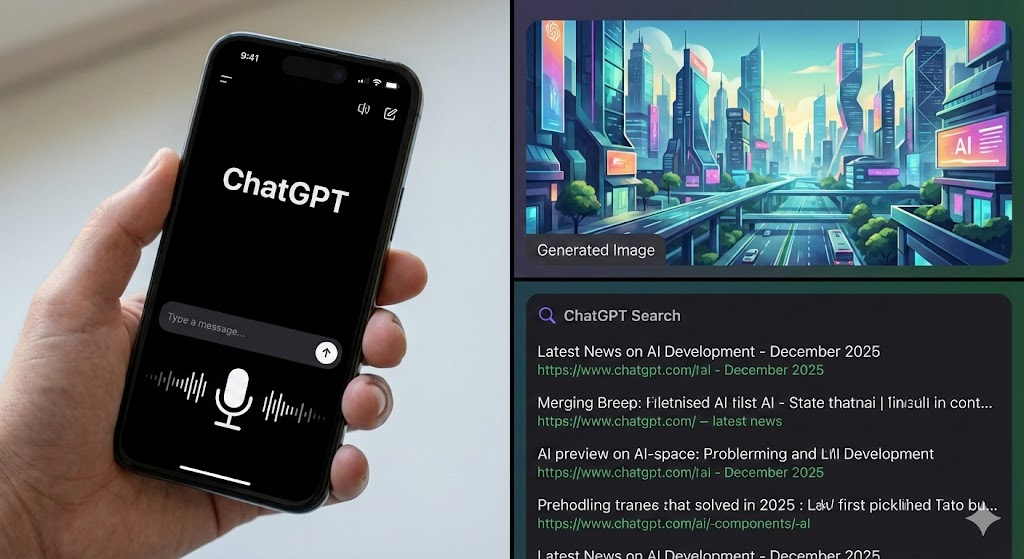
Forget the robotic voices of the past. ChatGPT in 2026 can whisper, sing, laugh, and detect emotional distress in your voice. It serves as a real-time translator, allowing two people speaking different languages to have a seamless conversation.
2. Vision and Image Generation
You can snap a photo of your fridge, and ChatGPT will suggest recipes based on the ingredients it sees. Conversely, using the integrated DALL-E 4 engine, you can ask it to “Paint a picture of a cyberpunk city in the style of Van Gogh,” and it will render a unique image in seconds.
3. Search and Browsing (ChatGPT Search)
ChatGPT is no longer cut off from the present. With ChatGPT Search, it browses the live web to find stock prices, sports scores, and breaking news, citing its sources with clickable links.
4. Custom GPTs
You don’t need to be a coder to build an app. Users can create “Custom GPTs”—specialized versions of ChatGPT.
- Example: A “Sous Chef GPT” that only talks about cooking.
- Example: A “Math Tutor GPT” that never gives the answer but guides the student.
ChatGPT vs. Traditional Search Engines
A common confusion for newcomers is thinking ChatGPT is just a better Google. They are fundamentally different tools.
| Feature | Search Engine (Google/Bing) | ChatGPT (Generative AI) |
|---|---|---|
| Primary Goal | Find information that already exists. | Create answers or synthesize information. |
| Output | A list of links (blue links). | A direct, conversational answer. |
| Creativity | None. It indexes facts. | High. Can write poems, code, and stories. |
| Accuracy | High (links to original sources). | Variable (can “hallucinate,” though improved in 2026). |
| Context | Stateless (mostly treats queries individually). | Contextual (remembers what you said 5 minutes ago). |
The Convergence: In 2026, these lines are blurring. Google has “AI Overviews,” and ChatGPT has “Search.” However, use Search for finding sources, and ChatGPT for understanding or creating from them.
Real-World Use Cases: Who is Using It?
ChatGPT isn’t just for students cheating on essays (though schools have adapted to that, too). It is reshaping the global workforce.
1. Software Development (Coding)
Developers use ChatGPT as a “Pair Programmer.” It writes boilerplate code, finds bugs in seconds, and translates code from one language (e.g., Java) to another (e.g., Python). It is estimated that 40% of all new code on GitHub in 2026 is AI-assisted.
2. Content Marketing & SEO
Marketers use it to generate blog outlines, write meta descriptions (like the one at the top of this post!), and repurpose long YouTube videos into short LinkedIn posts.
3. Education & Tutoring
Khan Academy and Duolingo have integrated GPT-4o to provide personalized tutors. If a student gets a math problem wrong, the AI explains why the specific step was incorrect, rather than just marking it red.
4. Enterprise & Business
Companies like Morgan Stanley use internal, private versions of ChatGPT to search through millions of PDF documents instantly. Customer support bots now handle 70% of queries without human intervention, resolving complex refund issues autonomously.

Limitations, Ethics, and Safety
Despite the hype, ChatGPT is not magic, and it is not without risk.
1. Hallucinations
“Hallucination” is the term for when an AI confidently states a fact that is completely false. While GPT-5 has reduced this by 80% compared to GPT-3.5, it can still invent court cases, quotes, or historical events. Always verify critical information.
2. Bias and Fairness
The model learns from the internet, and the internet contains bias. OpenAI works hard to filter this, but models can sometimes exhibit political or cultural biases depending on the phrasing of a prompt.
3. Data Privacy
In the free version of ChatGPT, your conversations may be used to train future models. This is a massive security risk for companies.
- Tip: Enterprise users and those who toggle “Memory & Training” off in settings can keep their data private.
4. The Copyright Debate
Artists and authors have sued AI companies, arguing that the models were trained on their copyrighted work without payment. This legal battle is ongoing in 2026 and will define the future economics of the creative industry.
The Future: AGI and Beyond
Where do we go from here? OpenAI’s stated mission is the creation of AGI (Artificial General Intelligence)—AI that is generally smarter than humans at most economically valuable work.
Predictions for 2026-2030:
- Robotic Integration: We are already seeing ChatGPT integrated into humanoid robots (like the Figure 02 robot). Soon, the “brain” of ChatGPT will have a “body” to do laundry or factory work.
- Hyper-Personalization: AI will not just be a website you visit; it will be an OS layer on your phone that knows your schedule, health data, and preferences, proactively managing your life.
- Scientific Breakthroughs: AI models specialized in biology (like Google DeepMind’s AlphaFold) combined with the reasoning of GPT-5 will likely accelerate cures for diseases and the discovery of new materials.
Conclusion
So, what is ChatGPT? It is a mirror of our collective knowledge, compressed into a mathematical file that you can talk to. It is a tool that can amplify human creativity or atrophy human critical thinking, depending entirely on how we choose to use it.
In 2026, the question is no longer “Will AI replace us?” The question is “How will you use AI to replace the boring parts of your life so you can focus on what makes you human?”
Start exploring today. Create a free account, ask it a hard question, and witness the future firsthand.
FAQ: Common Questions Answered
Is ChatGPT free to use in 2026?
Yes, OpenAI offers a generous “Free Tier” that uses the GPT-4o-mini model. However, for access to the most powerful reasoning models (GPT-5), higher usage limits, and image generation, a “Plus” subscription ($20/month) is required.
Does ChatGPT plagiarize content?
ChatGPT does not copy-paste text. It generates new sentences based on patterns. However, because it has read so much, it can accidentally reproduce very famous quotes or generic text closely. Always run AI work through a plagiarism checker if uniqueness is critical.
Can ChatGPT access the internet?
Yes. Modern versions of ChatGPT (both Free and Plus) can browse the internet to retrieve up-to-date information, weather, and news.
Is my data safe with ChatGPT?
For casual use, yes. But never put passwords, credit card numbers, or highly sensitive corporate secrets into the public chat. Use the “Temporary Chat” feature for sensitive discussions.
What is the difference between GPT-4 and GPT-5?
GPT-4 was a genius at text and reasonable at vision. GPT-5 introduces deep “system 2” reasoning (thinking before speaking) and massive memory capabilities, making it much better at complex tasks like coding entire apps or writing novels.